

Solana staking: The State of the Network and the Road to Fair, Fast Markets
In December 2025, the global Solana community got together for Breakpoint - Solana's annual flagship event. The agenda was packed, and we heard many insightful talks and breaking news announcements from the stage. In this series, we'll recap some of the most interesting talks from Breakpoint 2025.
The first talk in the series is from Anza, one of the teams that has been helping steer core protocol development on Solana.
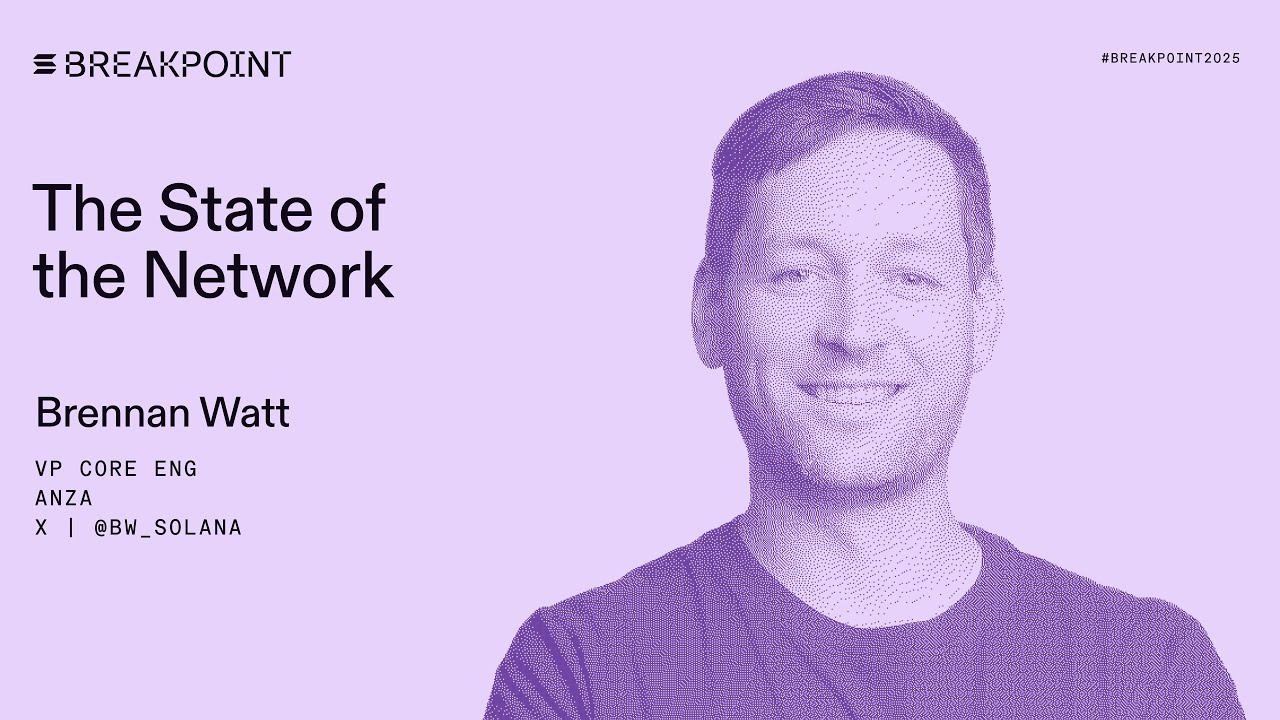
We are at a moment where reliability, raw speed, and economic design must all work together. Solana staking remains a core part of that picture: as throughput and finality improve, the incentives and reward flows tied to staking must scale with the new market structure. Anza's Brennan Watt breaks down where we are, what we've shipped, and the concrete changes coming that will make trading fairer and building onchain far more affordable.
Resilience first: engineering for boring big days
Reliability has been the quiet victory. Solana has processed nearly two hundred billion transactions with long stretches of consistent uptime. To keep those "big economic days" uneventful for users, projects and validators run relentless red teaming and stress tests against the network. These tests focus on two attack classes:
- Network denial of service scenarios to exercise back pressure, load shedding, and connection handling.
- Curated execution stress that pushes the far corners of the virtual machine and replay paths.
The result is fewer surprises during peak events. What used to destabilize nodes now barely registers. That kind of paranoia and automated testing is what lets the ecosystem ship fast and keep the network humming.
Anza performance: more block capacity, lower latency
This year Anza has increased per-block throughput and doubled capacity for the hottest accounts - the ones that used to bottleneck whole slots. Sustained ingestion rates have exceeded 100k TPS in bursts. A major enabler is bypassing the Linux kernel at the network layer, using XDP to eliminate costly data copies and context switches. The effect is dramatic: latency curves drop by orders of magnitude and validators can move far more transactions without slowing confirmation times.
What this means in practice
- 25 percent overall throughput increase without longer confirmations.
- Double the burst compute to critical accounts (from 12M to 24M compute units).
- Next step: doubling again to ~100M compute units per block.
Finality rethought: Alpenglow consensus
Alpenglow is the new consensus engine replacing Tower BFT. It targets transaction finality under 150 milliseconds while increasing safety around timing and equivocation handling. Anza has a globally distributed 50-node test cluster under continuous load and the engine is approaching feature completeness. Faster finality is more than a nice metric; it changes UX, enables snappier trading, and tightens the feedback loop for Solana staking rewards.
Market structure: ending single-builder monopolies
Building fair, efficient markets is the next frontier. Multiple concurrent proposers will break the single-builder model, giving traders and dApps optionality, censorship resistance, and reduced transaction hiding. Anza will ship incremental features toward this multi-proposer architecture across releases, making the market more competitive and transparent.
Lower rent and better economics for builders
High state costs have been a real barrier for projects and users. The Anza team is introducing an onchain, adjustable scheme to reduce the cost of state. This is not a tiny tweak: they plan meaningful reductions that make it dramatically cheaper to bootstrap large user bases and accounts.
"The rent is too damn high"
That sentiment drove the change. Lower state costs together with improved block capacity and faster finality make Solana an even stronger place to build.
Validators, stakers, and shared revenue
As trading activity grows, the Anza team is hoping for delegated stake to participate more directly in the economic upside. This is why they are simplifying how validators can share revenue with stakers and information providers within the protocol. Better in-protocol reward flows align incentives and ensure that Solana staking delivers fair access to the rewards generated by increased market activity.
Where we land
In short, the focus is threefold:
- Resilient operations that keep major days boring.
- Higher performance - more bandwidth, lower latency, and snappier finality.
- Fair, scalable economics that enable competitive markets and lower barriers to entry for builders.
Together, these changes create a single, unified state machine that synchronizes quickly and supports a premier trading experience for any asset. Solana staking sits at the heart of that design, and as we roll out these upgrades, staking participants will see the network become faster, fairer, and more rewarding.
Watch the full talk here: