

BULK Exchange: The Architecture That Pays Everyone to Win
A deep dive into the architecture, competitive forces, and stakeholder incentives behind Solana’s purpose-built perpetuals exchange.
Written by @nicostery | Chainflow is currently operating on the bulk testnet and helping push infrastructure forward.
Decentralized perpetuals trading on Solana has been, frankly, underwhelming. The chain that processes more daily transactions than any other blockchain still captures only a fraction of the on-chain perps market. The bottleneck is not demand, it is infrastructure. Solana's general-purpose runtime was never optimized for the nanosecond-level demands of a central limit order book. Market makers bleed capital to stale quotes. Takers eat wider spreads than they should. And validators, the backbone of the network's security, only sporadically benefit from trading fees through MEV.
BULK Exchange is designed around a single premise: fix the execution layer, and you fix the incentives for everyone - from traders and validators to passive stakers. It is rebuilding the execution stack from the validator up. And Chainflow is at the forefront, supporting this initiative as it pushes Solana forward.
The Core Architecture: A Formula 1 Track on a Superhighway
BULK T1 is a modular execution architecture that cleanly separates order matching (which must happen in milliseconds) from on-chain settlement (which can proceed at Solana's natural pace). The system is built on a fork of the Jito-agave validator client and introduces purpose-built components for high-frequency trading.
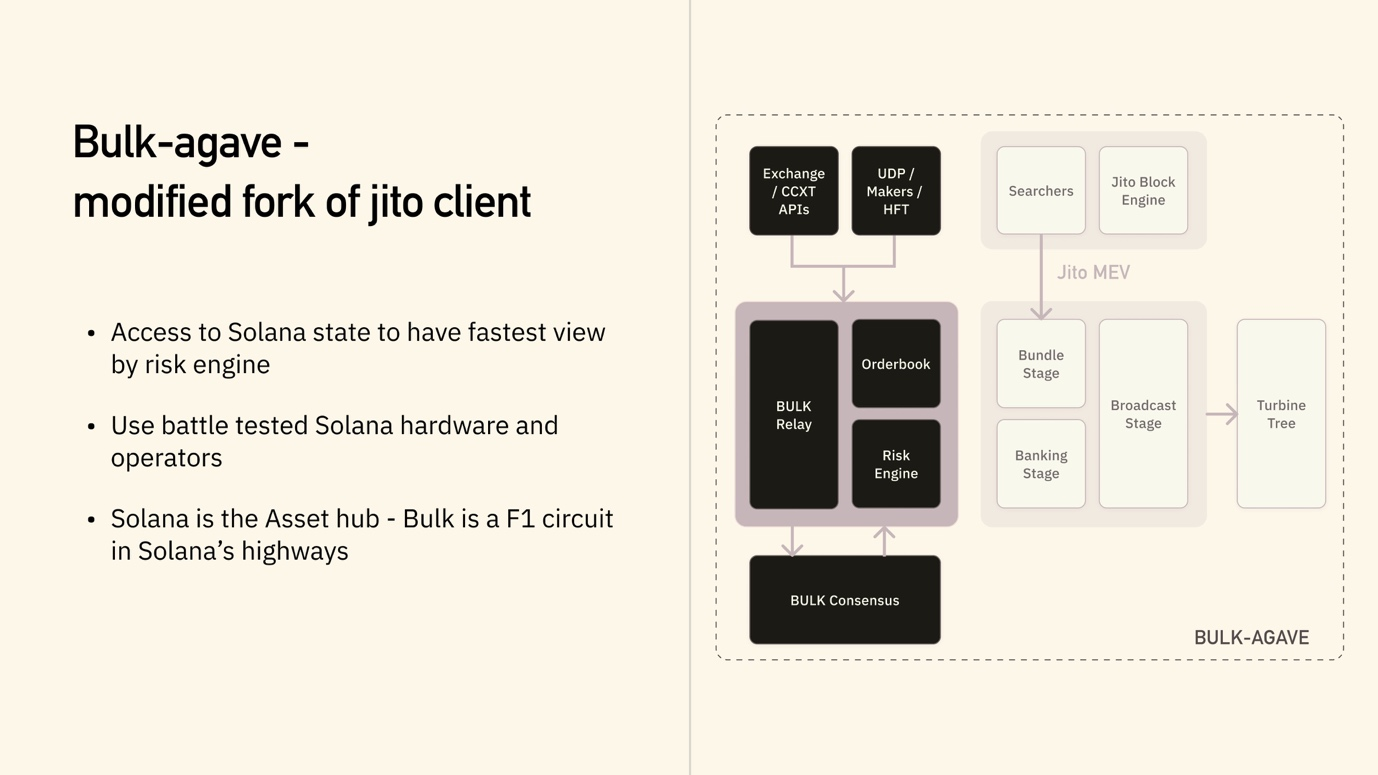
Bulk-agave is the core validator client. Because it extends rather than replaces Jito-agave, validators who adopt it do not sacrifice MEV revenue from Jito's blockspace auctions. They simply gain an additional revenue stream from BULK's order flow. Two systems share one machine and one validator identity, operating independently on separate networks.
The BULK Tile is the execution core: an in-memory matching engine, risk kernel, and liquidation engine running directly inside each validator node. By operating entirely in memory and outside of Solana's on-chain execution environment, the Tile escapes the latency constraints that cripple traditional on-chain orderbooks. The matching and risk engines are written in native Rust - no virtual machine interpretation, no gas markets, no blockspace contention.
BULK Net is a custom order propagation layer built on erasure coding and a UDP fan-out mechanism. It pushes orders to every validator in under 20 milliseconds, functioning as the nervous system that keeps all nodes synchronized.
BULK Db provides persistence. Each validator runs a key-value, log-structured database that is peer-replicated across the network, storing the canonical record of every trade fill and state change.
The Commit Path bridges everything back to Solana. It batches state deltas, aggregates cryptographic attestations from a quorum of validators using BLS threshold signatures, and periodically writes a single, compact proof to the Solana L1. No bridges. No external chains. Just Solana.
Guaranteed Fair Ordering Through Leaderless Consensus
BULK's consensus protocol has no leader. No single node proposes blocks, and every validator in the network participates as an equal.
A trader submits an order through BULK's API. The order enters a validator's ingress pipeline, is hashed and deduplicated, and is immediately broadcast via UDP to all validators in the network. Within milliseconds, every validator has received the same transaction.
Then comes the novel part: each validator builds a compact cryptographic sketch of the transactions it has seen — essentially a mathematical fingerprint of its pending set. Validators exchange these sketches in a single round using Minisketch (originally developed for Bitcoin Core). Each validator can then reconcile its sketch against every other, instantly discovering which transactions are shared and which are missing, all without needing to re-send full transaction data.
Once a supermajority of validators agree on the transaction set, the batch is committed. One vote exchange. One commit. One round. Consensus completes in 20ms.
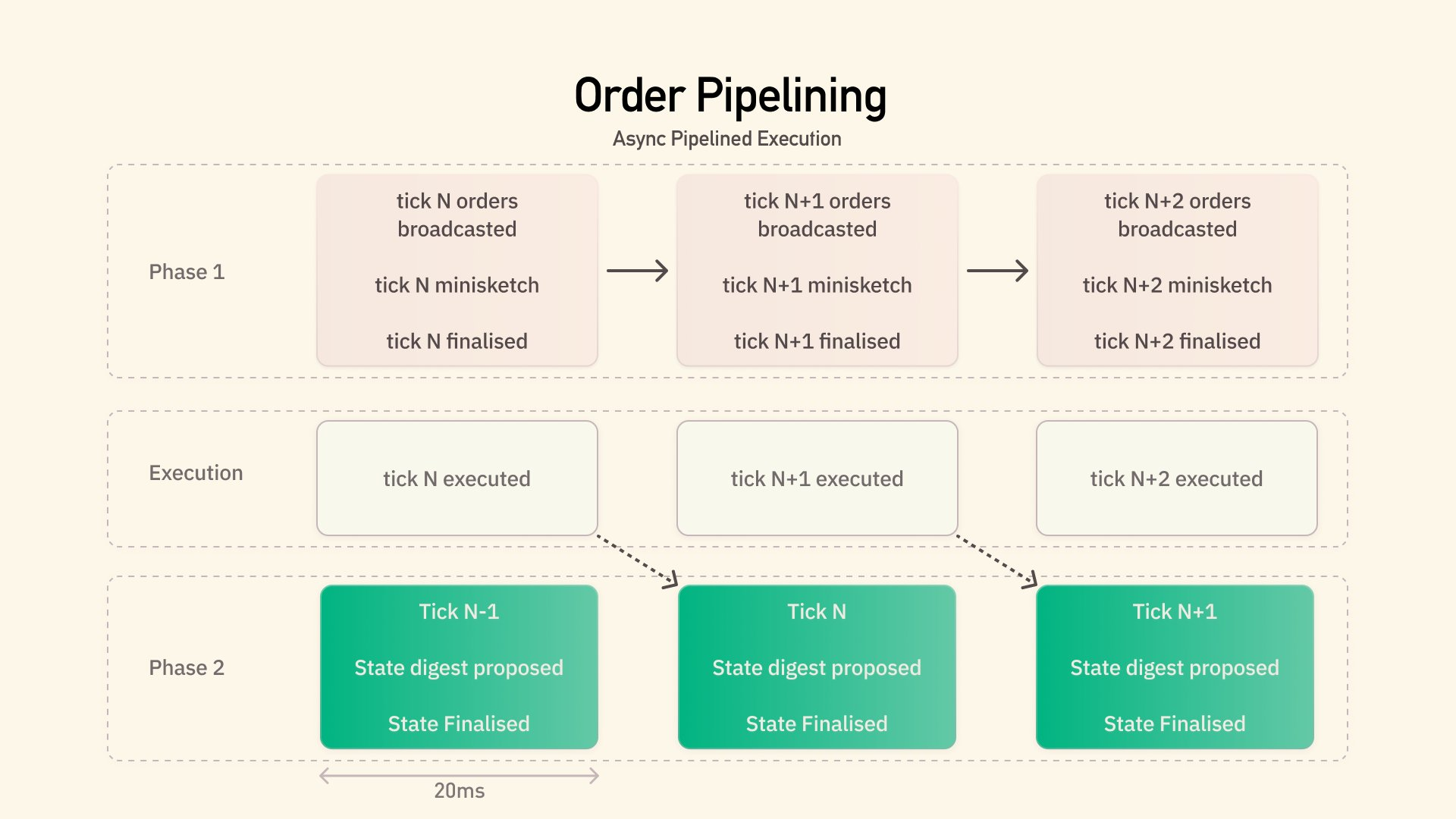
After the batch is committed, the execution layer applies a deterministic shuffle before matching. The shuffle is seeded by the batch timestamp - a value that no single validator controls and that cannot be predicted before commitment. Every validator computes the identical shuffle from the identical seed, making the ordering of transactions within a batch random, fair, and tamper-proof.
After shuffling, transactions are separated into priority queues and executed in a specific sequence: cancels first, then post-only orders, then regular orders. Cancels execute first so traders can always protect themselves. If you submit a cancel in the same batch as an adverse fill, your cancel wins. Post-only orders execute next, seeding the book with liquidity before aggressive orders can take it. Regular market and limit orders execute last, matching against a fully updated book.
Why Traders Care: Speed, Fairness, and Zero Gas
For makers, the current state on Solana is punishing. In the best case, placing and updating an order takes around 800 milliseconds across two full slots. In practice it is worse: makers fight each other and against takers just to land transactions, all while prices move underneath them. Solana's per-account write locks turn every orderbook into a contention bottleneck.
BULK sidesteps this entirely. The Tile matches orders in 5–20ms with trade finality arriving in roughly 40ms. Makers can update quotes at the speed they need to stay profitable. Takers benefit from tighter spreads driven by confident, well-maintained liquidity.
Submitting an order costs nothing. Canceling an order costs nothing. There is no gas market, no bidding for inclusion, and no priority fees that spike during volatility. You pay one fee: the exchange fee, charged only when your order fills. This is how every successful exchange in the world works. BULK brings it to DeFi.
BULK also provides institutional on-ramps from day one, including full CCXT and FIX API integration, comprehensive SDKs, and dedicated UDP endpoints for makers and HFT firms.
Institutional-Grade Risk Infrastructure
An exchange is only as good as its risk engine. Every perpetuals DEX on the market today calculates margin the same way: per-position, in isolation. Long 10x BTC? That is 10% margin. Also short 10x ETH? Another 10% margin required. The fact that these positions hedge each other and your real portfolio risk is a fraction of the sum is completely ignored.
Traditional finance solved this problem decades ago. CME has used portfolio margining since 1988 through their SPAN system (Standard Portfolio Analysis of Risk). No on-chain perpetual exchange has ever implemented anything close to this, until BULK.
Portfolio Margin: A DeFi First
BULK runs a native portfolio margin engine that is correlation-aware and regime-adaptive. If you are long $100K BTC and short $100K ETH with a BTC-ETH correlation of 0.85, your effective portfolio exposure is approximately $55K, not $200K. Hedged portfolios can see margin reductions of 70% or more compared to per-position margining.
Risk is not computed once at order placement and then forgotten. BULK's risk engine runs continuously on every validator, recomputing portfolio risk on every single tick. Compare this to accessing CME SPAN through a broker, which typically requires 50% of contract clearance price in margin. BULK provides comparable risk management methodology with a minimum of just $50 to trade, lowering the barrier by an order of magnitude.
The Risk Model Under the Hood
Beneath the surface, BULK's risk model is substantially more sophisticated than anything currently live on-chain. At its foundation is a Markov-like regime switching model that classifies current market conditions along both volatility and directional axes, then uses historical transition probabilities to project where conditions might head next. The engine also constructs liquidation maps, evaluates orderbook depth and nearby liquidation concentration, and models cross-asset correlations to reduce margin requirements for anti-correlated portfolios.
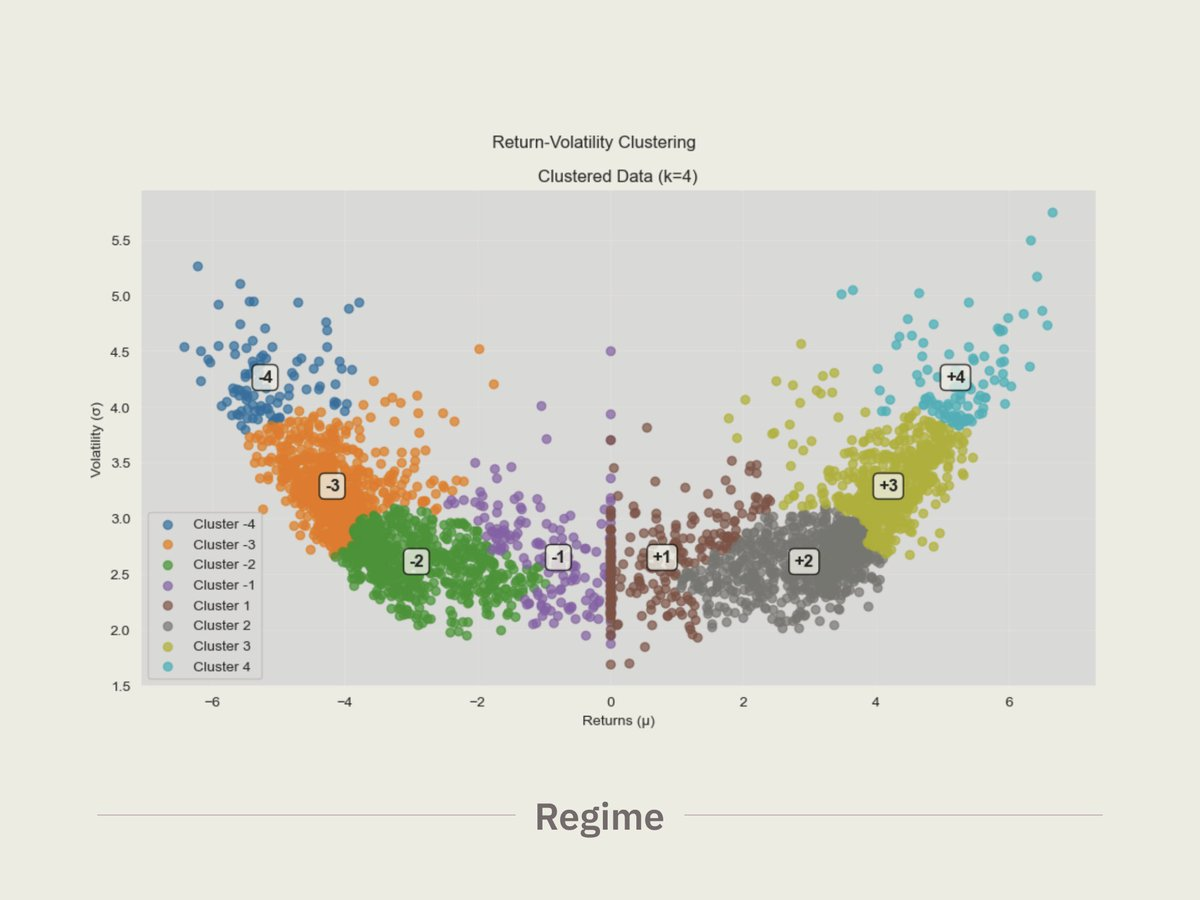
Monte Carlo simulations exploring both conditional Value at Risk and expected loss are run periodically, evaluating regime-switching stochastic differential equations for each starting regime and position direction. These produce multidimensional risk matrices that feed back into the real-time component, keeping margin calculations grounded in a robust statistical framework.
Liquidation as Optimization, Not Destruction
The way most DEXs handle liquidations today is crude. External keeper bots monitor margin ratios and, when a threshold is breached, close each underwater position individually through market orders. These bots have no visibility into the broader portfolio. They cannot tell whether the position they are about to close is actually functioning as a hedge that offsets risk elsewhere. Closing a hedging leg can increase a portfolio's net exposure, triggering cascading liquidations, the pattern behind virtually every major liquidation event in crypto's history.
BULK takes a fundamentally different approach. Its liquidation engine treats the problem as a constrained optimization: given a portfolio below maintenance requirements, what is the smallest, least disruptive set of position reductions that restores the account to health? The system scores each position by its ratio of margin relief to expected market impact. Positions that serve as hedges (where unwinding them would worsen the portfolio's risk profile) are left intact. This mirrors the default management processes used by major clearing houses in traditional finance, and it has never been implemented on-chain before.
Composable Collateral
Because BULK models the intrinsic value of collateral and its correlations with the trading portfolio, it can accept a wider range of assets beyond stablecoins. This includes staked SOL (such as BulkSOL) that continues earning yield, lending positions from protocols like Kamino and Loopscale, and fixed-income or structured yield tokens.
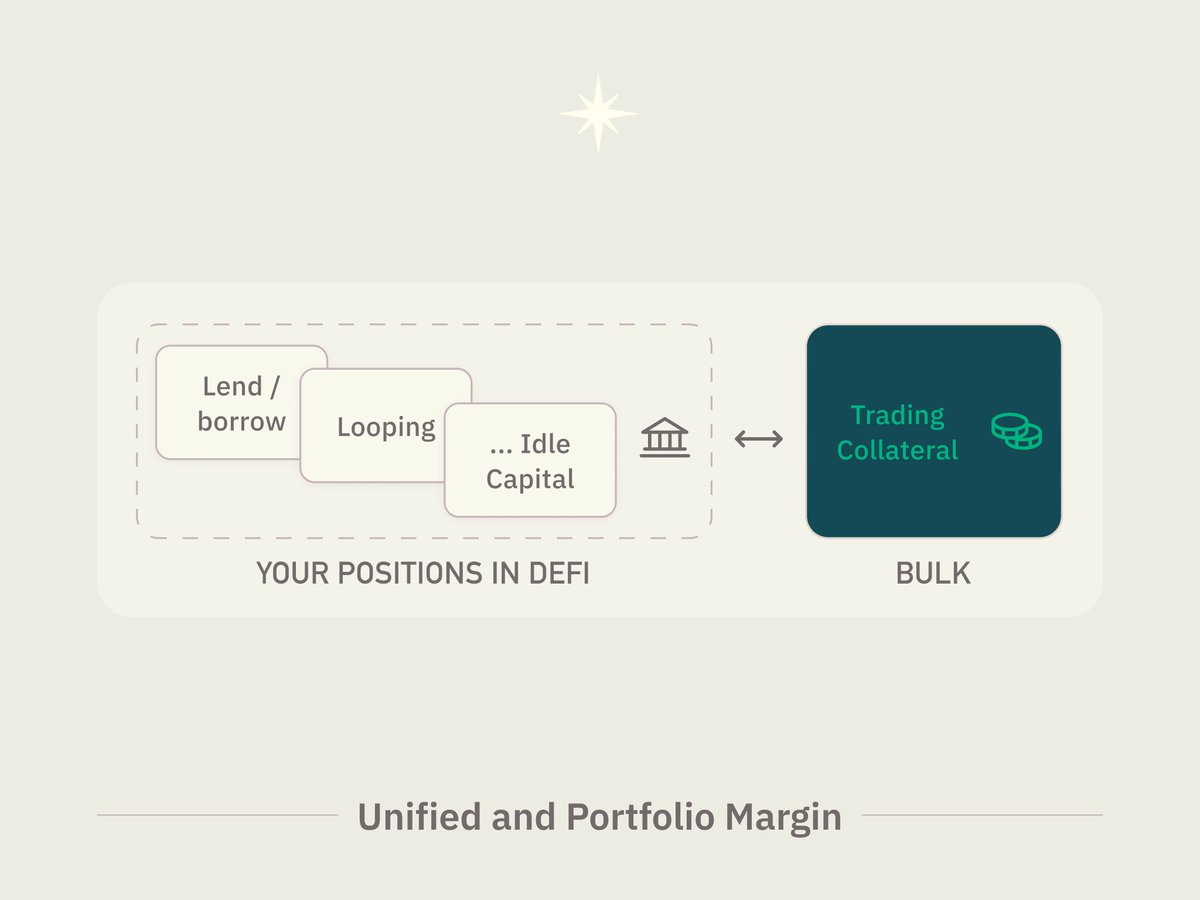
Building on Solana gives BULK access to one of the most developed DeFi ecosystems from day one. Composability with protocols like Kamino, Loopscale, Ranger, Titan, and Exponent gives users more ways to put their capital to work while providing more collateral options for trading, all without needing to unwind existing positions.
Why Validators Care: A New Revenue Stream Without the Tradeoff
This is where BULK's architecture creates a genuinely novel economic dynamic within Solana's ecosystem.
Validators who run the Bulk-agave client do not just process trades, they earn from them. BULK shares 12.5% of all taker fees directly with participating validators, paid in USDC. This revenue did not exist before. It does not come at the expense of Jito MEV earnings, and it does not require validators to run exotic hardware or adopt a fundamentally different operational model. They install an upgraded client that forks from the software they are already running, and they start earning from BULK's order flow on top of everything else.
The leaderless consensus mechanism distributes responsibility evenly. A tick commits on the fast path when 80% or more of stake-weighted validators agree. Even with up to 20% of validator stake acting maliciously and another 20% offline, the system maintains safety and liveness. Validators that consistently produce divergent results are automatically jailed, temporarily excluded from matching to protect network health.
This creates a competitive dynamic: validators are incentivized to run Bulk-agave both for the direct fee revenue and for the long-term strategic positioning it affords. As inflation schedules taper and traditional staking rewards compress over time, diversified revenue streams become existential for validator operations.
Why Passive Stakers Care: Rising Tides Lift All SOL
BULK's fee-sharing mechanism flows revenue through validators down to their delegators. A staker who delegates to a Bulk-agave validator earns base inflation rewards, plus Jito tip distributions, plus BULK's exchange fee share, all from the same staked position with zero additional effort or risk.
Solana's native staking yields currently sit around 6-7.5% APY, with Jito adding meaningful MEV-derived boosts on top. BULK adds yet another layer to this stack. As the exchange scales and generates meaningful trading volume, validators running Bulk-agave become objectively more attractive delegation targets.
This is a flywheel: more trading volume generates more fees, which attract more validators, which attract more stake, which strengthens the network, which attracts more traders. The architecture is designed so that each participant's rational self-interest reinforces the system as a whole.
Censorship Resistance and Decentralization
The BULK team is unequivocal on one point: in a financial system built around derivatives trading, transaction ordering and execution must be independent of any single authority.
The stakes are not abstract. If you have a position open, liquidation is 10 basis points away, and you try to close, on every centralized exchange and every single-sequencer DEX, there is no guarantee your close is processed without bias. When one operator controls the sequence of execution, users simply have to trust that operator not to abuse its position.
BULK's leaderless design eliminates this trust assumption entirely. There is no single sequencer that can censor or delay an order. The exchange is operated by a decentralized, global set of Solana validators who choose to run Bulk-agave. If any subset goes offline or acts maliciously, the network continues. No central point of failure, no bridge to exploit, no external chain to trust.
As the team puts it: without censorship resistance, the entire system is just another self-custody layer with centralized execution.
Looking Ahead
BULK’s Alphanet is live and Chainflow is at the forefront supporting initiatives pushing Solana forward. While a robust perpetuals offering will be BULK’s flagship product, the team has signaled that the network’s capabilities extend to many more applications over time.
One exchange. Infinite markets. And, if the architecture delivers on its promise, a rising tide for every participant in Solana’s ecosystem.
Join us and support our work by staking SOL with Chainflow:
Stake on staking.kiwi | Stake on chainflow.io
Have thoughts or feedback? Connect with us on X!