

Breakpoint 2025: Layer 33 and the Fight to Keep Solana Decentralized
In December 2025, the global Solana community got together for Breakpoint - Solana's annual flagship event. The agenda was packed, and we heard many insightful talks and breaking news announcements from the stage. In this series, we'll recap some of the most interesting talks from Breakpoint 2025.
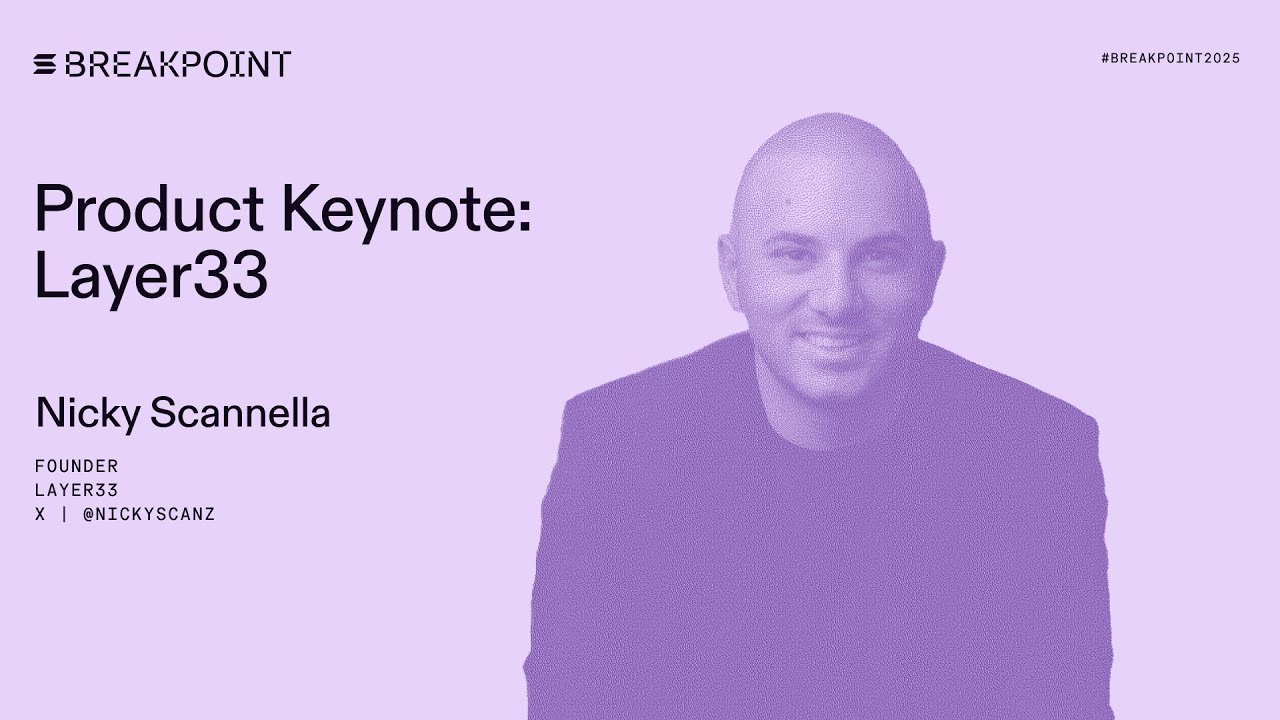
Today we look at Layer33's Nicky Scannella talk on the state of returns on the network.
Why independent validators matter
Decentralization is not an abstract ideal - it is the backbone that keeps Solana resilient, innovative, and community-driven. Indie validators are the unsung infrastructure builders: they operate nodes, contribute open-source tooling, run public goods, and incubate protocols that the whole ecosystem relies on.
By indie ве mean operators who are free from outside funding and venture capital (и.е. the opposite of institutional). Indie should feel a little rock and roll: nimble, daring, and community-first.
The problem: indie validators are under pressure
Running a validator used to be accessible. A decade ago a validator could be run with tens of thousands of SOL. Today the economics have shifted dramatically. A typical validator operator now needs on the order of 160,000 SOL to break even. That magnitude of stake is not practical for the mom-and-pop operators who originally secured and built much of the network.
The numbers are stark: over the last year more than a thousand nodes have disappeared. The count went from roughly 2,000 validators to under 800. Some of that attrition cleaned out underperforming and bad actors, which is healthy. But many high-quality, contributing indie validators are also leaving quietly because the economics no longer make sense.
Why this is dangerous
Centralization is not an immediate doomsday scenario, but it is a real threat to permissionless innovation. Institutional operators have fiduciary duties to their stakeholders. Their priority is capital efficiency and returns — not decentralization. Over time, stake concentrating in a few large operators weakens network diversity and the culture of public-good contribution that made Solana attractive in the first place.
Practically speaking:
- Top 80 validators control about 66% of the network, leaving a narrow slice for independent hands.
- 33% stake concentration is a threshold often discussed as critical for network safety; while not imminent, the trend is moving in the wrong direction.
Layer 33: A coalition to preserve indie infrastructure
Layer 33 is a coalition of 25 independent validators who are committed to keeping Solana decentralized, performant, and secure. Its goal is simple and ambitious: help secure 33% of Solana stake on independent validators. That does not mean Layer 33 must reach 33% alone - the goal here is for this model to be copied and expanded by other coalitions and teams.
In one month Layer 33 already represents about 4% of the target 33%. That momentum matters because it proves indie validators can organize, pool resources, and deliver meaningful infrastructure without institutionalization.
What Layer 33 provides
Becoming an enduring core infrastructure provider means offering services indie validators need to survive and scale. Initial offerings include:
- RPC and gRPC endpoints to improve reliability and performance for projects and dapps.
- Transaction landing and routing to ensure smooth user experiences and efficient block inclusion.
- Educational programs to train operators, contributors, and new tooling projects (for example, collaborations like BlueShift and Greet Academy).
- Public-good support and story-telling to amplify the work of indie operators and help projects get discovered.
Those are just the start, and more services and partnerships are planned in the coming months to expand technical capacity and lower the barrier to entry for new independent operators.
Indie LST: a funding and sustainability tool
To create sustainable funding for Layer 33, the collective launched an liquid staking token (LST) called Indie Soul. It is available on Jupiter for swapping SOL into Indie Soul. The product is designed to be high-performance and yield-bearing, with fees directed back to support Layer 33’s operations and public-good work.
How people and projects can help
Indie validators need practical support. If you care about a healthy, decentralized Solana, consider these ways to contribute:
- Use infrastructure and services provided by indie operators.
- If you’re launching a public good, partner with independent validators or Layer 33 for technical and operational support.
- Join or build validator coalitions to spread stake across trusted independent operators.
- Swap SOL into Indie Soul to help fund public-good maintenance and validator sustainability.
- Amplify indie stories and share the work of small operators who maintain crucial open-source tools.
Final note
The future of Solana doesn’t have to be a choice between institutional control and chaos. Independent validators are irreplaceable since they build the tooling, the culture, and the public goods that power long-term growth. Layer 33 exists to give those operators a louder voice, a stronger balance sheet, and the infrastructure they need to continue contributing.
Independence has always been the creative engine of permissionless systems. Keeping that engine running requires coordination, new funding approaches, and a willingness to build commons rather than concentrate control.
Join the effort
If you run a project, operate a validator, or care about decentralization, reach out, partner, or follow the coalition’s updates. There’s room for many more groups to form and secure that 33% together. We at Chainflow are proud members of Layer33.
Watch the full talk here: